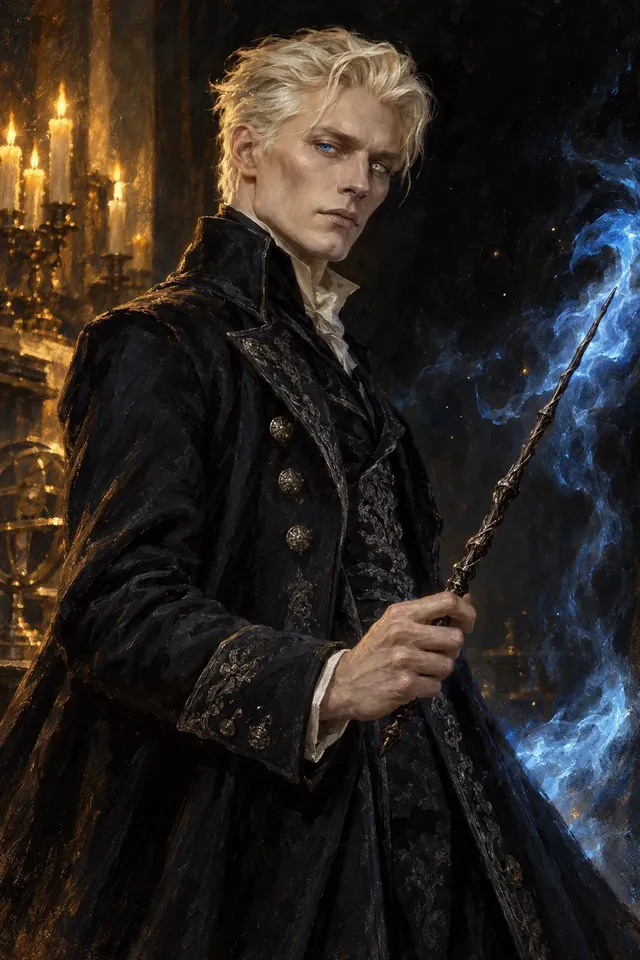
House not confirmed
Gellert Grindelwald: The Dark Wizard Dumbledore Defeated
The Dark wizard before Voldemort
- Wand
- Elder Wand (stolen from Gregorovitch)
- Occupation
- Dark wizard, defeated by Dumbledore in 1945
- School
- Durmstrang (expelled)
- Died
- Killed by Voldemort at Nurmengard
Before Voldemort there was another wizard who wanted to rule over Muggles, and he had a friend who would end up defeating him. Gellert Grindelwald is Dumbledore's dark past and the reason the Elder Wand changed hands so many times.
Who he is
Grindelwald was a brilliant and dangerous wizard. He studied at Durmstrang until he was expelled for experiments that went too far. His motto was "For the Greater Good," and he used it to justify wizards ruling over Muggles (Deathly Hallows, ch. 18). Dumbledore defeated him in 1945, a fact that appears even on the Chocolate Frog cards (Philosopher's Stone, ch. 6).
A note on the movies: in Fantastic Beasts he appears in more detail, with some events the books don't tell. This profile uses only the books.
Key moments
- Deathly Hallows, ch. 8: Krum recognizes the sign of the Hallows and says Grindelwald carved it into a wall at Durmstrang.
- Deathly Hallows, ch. 18: in Dumbledore's biography, Harry reads about the friendship they had one summer in Godric's Hollow.
- Deathly Hallows, ch. 24: Ollivander says Grindelwald stole the Elder Wand from Gregorovitch.
- Deathly Hallows, ch. 28: Aberforth tells how the duel between Dumbledore, Aberforth and Grindelwald ended with Ariana's death.
- Deathly Hallows, ch. 35: Dumbledore admits to Harry how dazzled he was and how ashamed of it he is.
Relationships
With Dumbledore he had a teenage friendship full of dangerous ideas, and from it came a guilt Dumbledore carried all his life. With Bathilda Bagshot, the historian, he spent a summer in Godric's Hollow, since he was her great-nephew (Deathly Hallows, ch. 18). With Voldemort he crossed paths at the end: Voldemort went looking for the Elder Wand in his prison at Nurmengard and killed him.
What almost nobody notices
The letter young Dumbledore wrote him, with the phrase "For the Greater Good," appears in Rita Skeeter's biography (Deathly Hallows, ch. 18). Harry reads it with pain, because he sees his mentor shared an idea he later fought all his life. That letter matters more than any duel, because it shows Grindelwald wasn't an obvious monster to those who knew him: he was a brilliant boy with seductive ideas.
The Elder Wand, which Grindelwald stole, is what decides the end of the last book.
To see which house you'd be in, take the house quiz.
Content created with AI assistance, reviewed and edited by our editorial team.