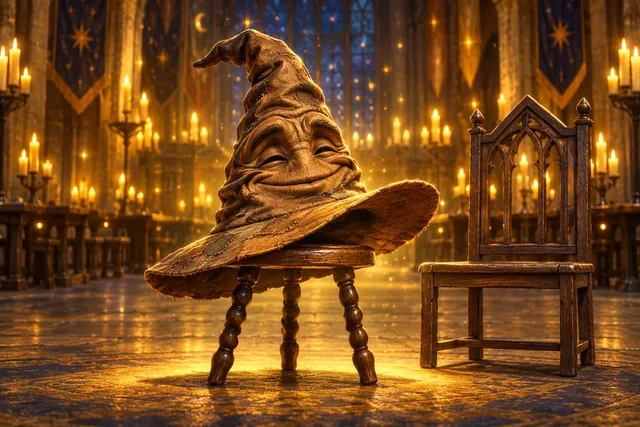
The Hat and the quiz
Sorting Hat Quiz: How It Works and What It Measures
We made a house quiz that doesn't ask your favorite color. It asks what you'd do in specific situations, when nobody's watching. There are thirteen questions, and at the end the Hat "thinks" on screen before giving you your house. Here we explain, plainly, what it does and what it doesn't.
Almost every quiz online promises magic and doesn't tell you how it reaches the result. Ours is simple, and we'd rather you know.
How It Works, Step by Step
- You enter your name (optional). Before starting, you can type your name or nickname. It personalizes the result and the card you can share. If you leave it empty, the quiz works the same.
- You answer thirteen questions. Each one describes a situation or asks you something about yourself: what you do if a friend is in danger, which quality you value most, what you do if you find a bag of gold on the street, what your deepest fear is, how people would describe your worst version.
- You pick one of four answers per question. Each answer belongs to a house: Gryffindor, Ravenclaw, Hufflepuff or Slytherin.
- The Hat "thinks." When you finish, an animation appears with lines from the Hat ("I see courage in your heart... but also cunning..."). It's purely visual: the result is already calculated and doesn't change based on what the Hat says.
- You get your house. You'll see your house with its crest, a description and your name on top.
How the Result Is Calculated
The calculation is a simple count: every answer you pick adds a point to the house it belongs to. At the end, the house with the most points wins. There are no secret weightings, no questions that count double and no artificial intelligence.
Three details worth knowing:
- In a tie, the last question you answered decides. If two or more houses finish level, the house you picked on question thirteen wins. If that answer belongs to a house that isn't tied, the program steps back through your answers, from last to first, until it finds one that belongs to one of the tied houses. It's a fixed, explicit rule, not a "magical" criterion. With a 4-4-3-2, for example, the tied house you picked closest to the end wins.
- The result only shows the winning house. It doesn't show you the breakdown (for example, 5 points Gryffindor and 4 Slytherin), so you don't know how close you came to another house.
- The order of the answers is fixed. It isn't shuffled randomly between attempts.
What It Measures and What It Doesn't
It measures decision tendencies: whether you tend to act right away, analyze first, look after the people around you or calculate what suits you. That logic follows the idea we developed in The Sorting Hat Almost Put Harry in Slytherin: What Happened: what matters is what you choose, more than what you know.
It doesn't measure intelligence, it doesn't evaluate you psychologically and it doesn't predict your personality. It's an entertainment quiz, made by fans, with thirteen questions. There's also no question that lets you say directly "I want to be Gryffindor"; the idea is for you to find out from your answers, not from your wishes.
One limitation worth admitting: the quiz can't tell whether you're answering honestly. In the bag of gold question, all four answers are defensible (find the owner, research how to handle it properly, hand it in without hesitation, or hand it in but negotiate a finder's reward and invest it wisely), and the Slytherin one is about ambition and cunning, not theft. That used to be different: the answer was to keep the gold, and we fixed it. Even so, a question or two still keeps a less likable option than the others; for example, the one about discovering a classmate cheating, where the Slytherin answer is to use it as leverage. If you answer thinking about how you'd look best instead of how you'd really act, the result will tell you less about yourself. It works best if you answer fast and without strategy.
What It Does Include
- Spanish and English. The quiz is available in both languages.
- Your result card. It generates an image ready to share or save. On phones with a share function, it's sent as a file; on a computer, it downloads.
- Eight other quizzes. Besides the house quiz, the site has quizzes for Patronus, wand, magic school, magical lineage, Ministry job, Horcrux, hero or villain and magical creature.
- Free, no sign-up. It doesn't ask for an account. Your name, if you type it, is saved in your own browser so it doesn't ask again.
What It Doesn't Have
It has no "mixed" results or second house, it doesn't offer percentages and it does no evaluation beyond those thirteen questions. It also doesn't keep a history of your results on a server.
How to Get More Out of It
- Answer with the first thing you'd do, not with what would look best.
- Take it more than once, on different days: if the same house comes up, the result carries more weight.
- Then read the article for your house. Start with Gryffindor House Explained: What Nobody Tells You, then Slytherin House: Why It Isn't the House of the Villains, Ravenclaw House: Helena's Wound and Luna's Freedom and Hufflepuff House: The Most Underrated House at Hogwarts.
When you want to check for yourself, go to house quiz.
Frequently Asked Questions
How long does the quiz take?
Thirteen single-choice questions. It generally takes a few minutes.
Is my result official?
No. It's a fan quiz, for entertainment, with no connection to the books beyond the qualities they describe. There's no "official quiz" that determines your house.
Can I retake it and get a different house?
Yes. If your answers change, so does the result. And if you're close to two houses, it's normal for one to come up sometimes and the other at other times.
This article has a video version on our TikTok.
Content created with AI assistance, reviewed and edited by our editorial team.
Characters in this article
More articles
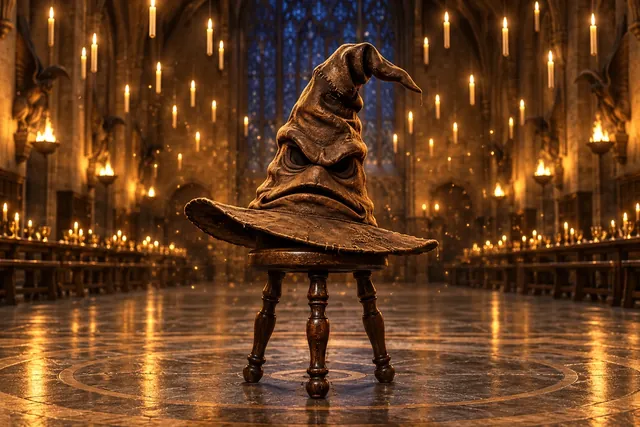
The Sorting Hat Almost Put Harry in Slytherin: What Happened
The Sorting Hat wanted to put Harry in Slytherin. What it told him, why it changed its mind and the Dumbledore line that explains everything.
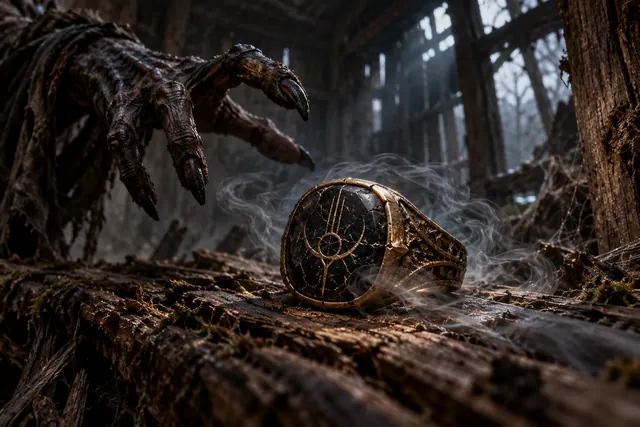
Gaunt's Ring: The Horcrux That Doomed Dumbledore
The story of Marvolo Gaunt's ring, the Resurrection Stone and the curse that sealed Dumbledore's death. Book chapters, movie differences and details.

Gryffindor House Explained: What Nobody Tells You
Gryffindor isn't the house of the good guys, it's the house of impulse. Pettigrew, Sirius, James and Neville show what courage really means in the books.